

Key Research Studies Supporting GASTROBIM™
Bimeda Animal Health | First FDA-Approved Generic Omeprazole Oral Paste | ANADA
The following four studies establish the clinical evidence base for omeprazole in the treatment and prevention of Equine Gastric Ulcer Syndrome (EGUS). GASTROBIM™ (omeprazole) oral paste is bioequivalent to GastroGard® and carries the same FDA-approved indications: treatment at 4 mg/kg SID × 28 days and prevention of recurrence at 2 mg/kg SID × 28 days.
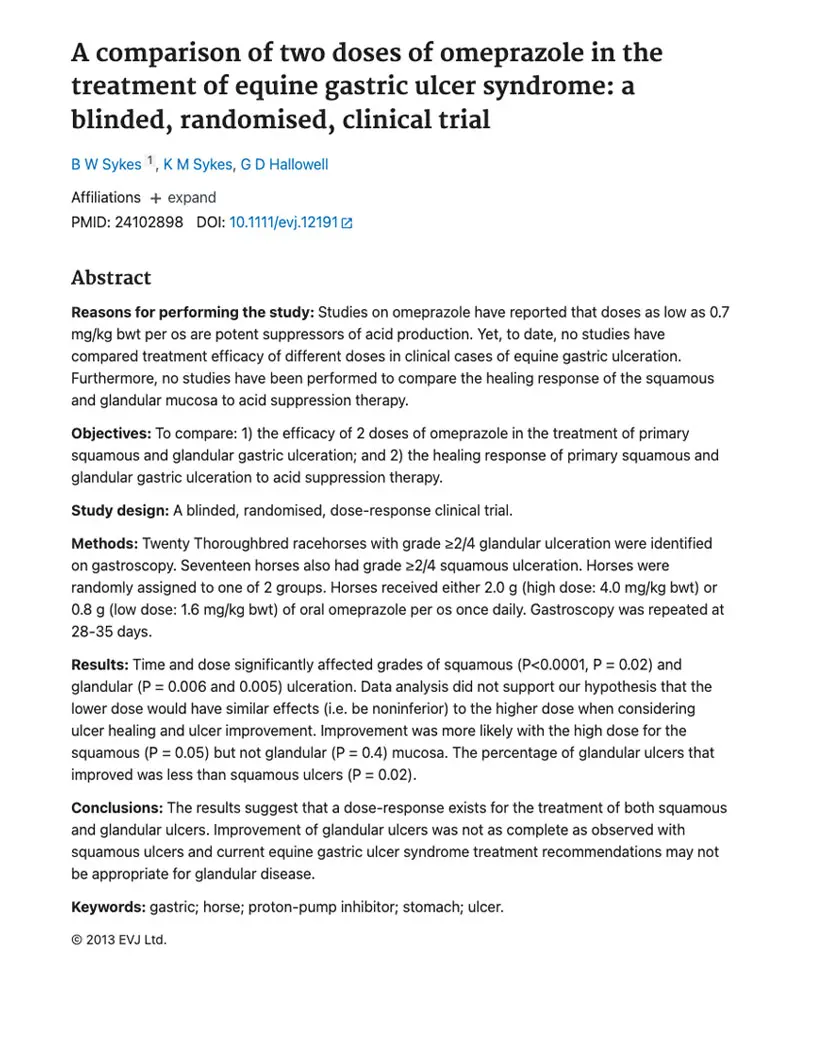
Study 1 — Sykes et al. (2013) — Equine Veterinary Journal
"A Comparison of Two Doses of Omeprazole in the Treatment of EGUS"
Design: Blinded, randomized, dose-response clinical trial.
Animals: 20 Thoroughbred racehorses with grade ≥2/4 squamous and/or glandular ulceration confirmed on gastroscopy.
Key Findings: A significant dose-response was demonstrated for squamous ulcer healing. Improvement was more likely with the higher dose (4 mg/kg) for squamous mucosa (P = 0.05). Squamous ulcers improved at a significantly higher rate than glandular ulcers (P = 0.02), establishing omeprazole as the first-line agent for ESGD specifically.
Clinical Relevance: Confirms ESGD responds robustly to omeprazole PPI therapy and supports the 4 mg/kg treatment dose.
Sykes BW et al. Equine Vet J 2014; 46(4):416–421. PMID: 24102898
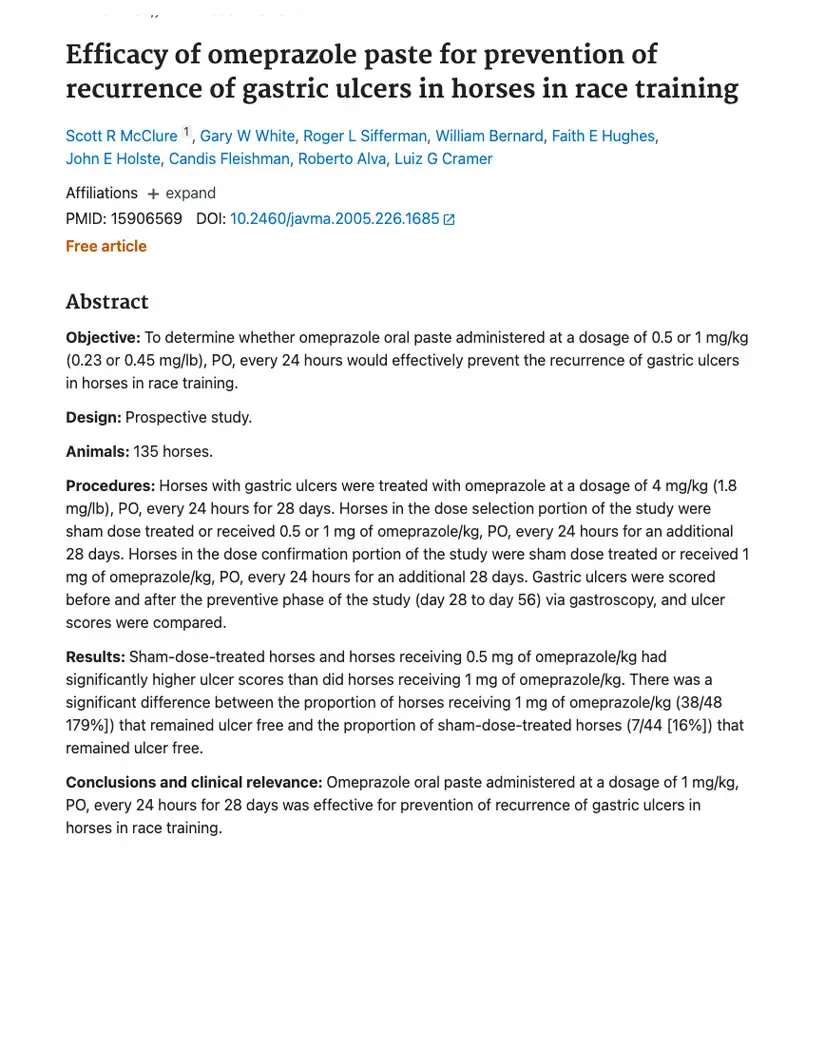
Study 2 — McClure et al. (2005) — Journal of the American Veterinary Medical Association
"Efficacy of Omeprazole Paste for Prevention of Recurrence of Gastric Ulcers in Horses in Race Training"
Design: Prospective, multicenter, randomized controlled trial.
Animals: 135 horses in active race training.
Procedures: Horses with confirmed gastric ulcers were treated with omeprazole at 4 mg/kg PO SID for 28 days, then randomized to sham, 0.5 mg/kg, or 1 mg/kg PO SID for an additional 28-day prevention phase. Gastroscopy performed before and after prevention phase.
Key Findings: Horses receiving 1 mg/kg had significantly lower ulcer scores than sham-dosed horses. 79% of horses receiving 1 mg/kg omeprazole remained ulcer-free vs. only 16% of sham-treated horses. The 0.5 mg/kg dose was not significantly different from sham.
Clinical Relevance: Directly supports the 1 mg/kg (2 mg/kg = half-dose label) maintenance protocol for prevention of ulcer recurrence — the same dosing carried on the Gastrobim™ ANADA label.
McClure SR, White GW, Sifferman RL, et al. JAVMA 2005; 226(10):1685–1688. PMID: 15906569
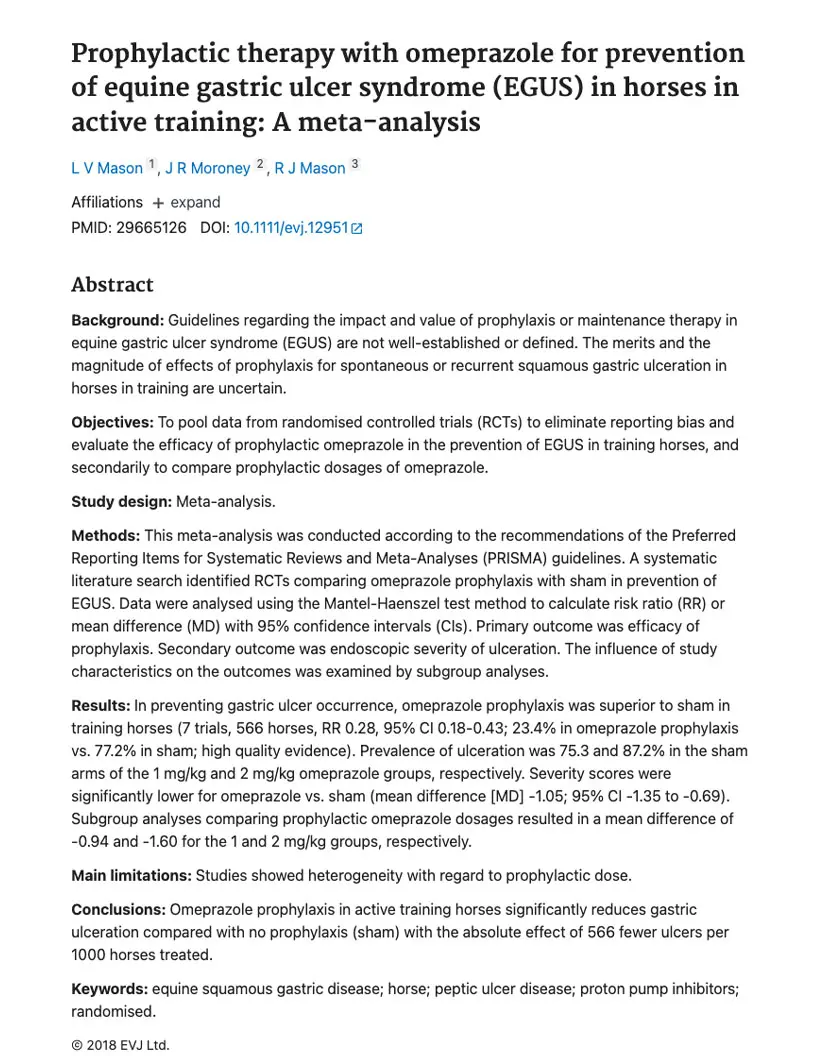
Study 3 — Mason et al. (2019) — Equine Veterinary Journal [Meta-Analysis]
"Prophylactic Therapy with Omeprazole for Prevention of EGUS in Horses in Active Training"
Design: PRISMA-compliant meta-analysis pooling data from multiple randomized controlled trials.
Objective: To eliminate reporting bias and evaluate the efficacy of prophylactic omeprazole in the prevention of ESGD in training horses, and to compare prophylactic dosages.
Key Findings: Omeprazole prophylaxis significantly reduces squamous gastric ulceration in active training horses compared to no prophylaxis. Absolute effect: 566 fewer ulcers per 1,000 horses treated.
Clinical Relevance: Strongest level of evidence supporting omeprazole prophylaxis for ESGD in performance horses. Reinforces the value of omeprazole maintenance dosing throughout a competitive season.
Mason LV et al. Equine Vet J 2019; 51(6):723–730. PMID: 29665126
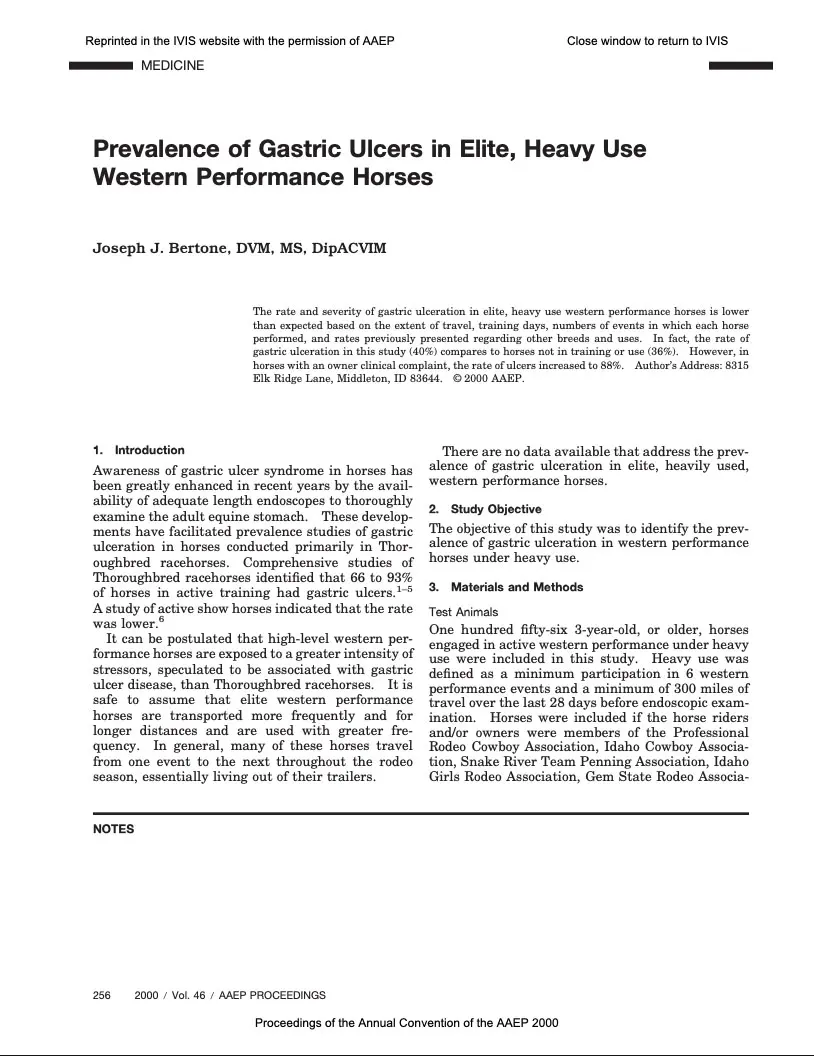
Study 4 — Bertone (2000) — AAEP Proceedings
"Prevalence of Gastric Ulcers in Elite, Heavy Use Western Performance Horses"
Design: Prevalence study using gastroscopy with clinical history collection.
Population: Elite western performance horses competing under NBHA, NRHA, NCHA, USTRC, team penning, intercollegiate rodeo, and related organizations.
Key Findings: Gastric ulcer prevalence of approximately 40% documented in elite western performance Quarter Horses subject to frequent travel and intensive training. While possibly lower than Thoroughbred racehorses (up to 93%), this prevalence confirms that western performance horses represent a significant at-risk patient population for ESGD. The Merck Veterinary Manual corroborates: gastric ulcers are found in more than 60% of show horses, event horses, western performance horses, and endurance horses, with prevalence increasing with exercise intensity.
Clinical Relevance: Directly applicable to barrel racing, reining, cutting, roping, and rodeo horses. The omeprazole treatment and prevention data from Studies 1–3 apply regardless of discipline, as the acid-injury mechanism driving ESGD is the same across breeds and performance types.
Bertone JJ. AAEP Proceedings 2000; Vol. 46:256–259.